
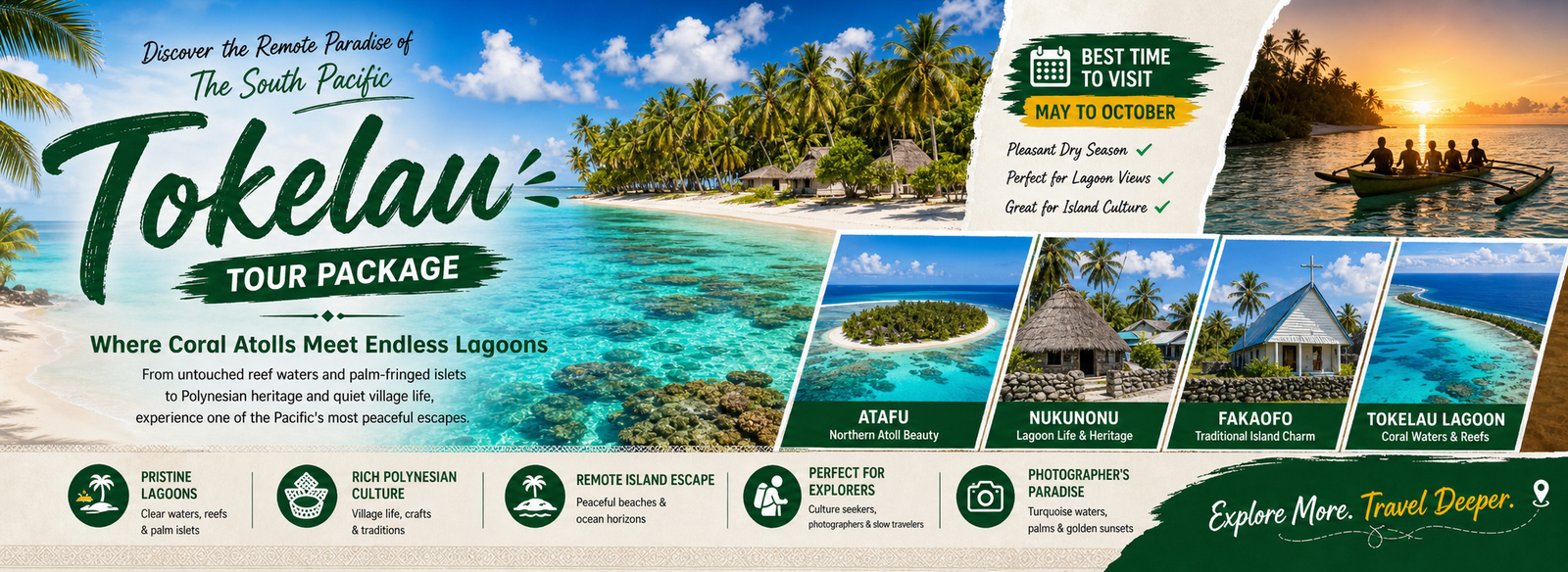
Destination Name: Tokelau
Region: Oceania / Polynesia / South Pacific
Status: Non-self-governing territory within the Realm of New Zealand
Famous For: Atafu, Nukunonu, Fakaofo, remote coral atolls, traditional Tokelauan culture, lagoon life, reef fishing, community-based living, climate-change awareness, Polynesian heritage, untouched island scenery, and being one of the world’s hardest-to-reach inhabited territories.
Tokelau is one of the most remote destinations in the South Pacific, made up of three small coral atolls: Atafu, Nukunonu, and Fakaofo. It is not a normal tourist destination and has very limited visitor infrastructure, no airport, no large hotels, and no mass tourism. Tokelau is best suited for researchers, cultural travellers, documentary travellers, experienced Pacific explorers, and visitors with official permission or local/community connections. Its main appeal is authentic Polynesian community life, lagoon landscapes, reef environments, traditional culture, and deep climate-change relevance.
Best Months: May to October
Good Months: April and November
Rainiest Months: December-March
Best for Sightseeing: May-October
Best for Cultural Visits: May-October
Best for Photography: May-October
Best for Lagoon Views: May-October
Best for Research Travel: May-October
Best for Boat Travel: May-October, depending on sea conditions
Solo Travelers: 🟧⭐⭐
Couples: 🟧⭐⭐
Families: 🟧⭐⭐
Friends / Groups: 🟨⭐⭐⭐
Honeymooners: 🟥⭐
Senior Citizens: 🟧⭐⭐
Adventure Seekers: 🟨⭐⭐⭐
Luxury Travelers: 🟥⭐
Budget Travelers: 🟨⭐⭐⭐
Recommended Stay: 5-10 Days, depending on ship schedule and permission
Weekend Trip Possible? No, Tokelau has no airport and can only be reached by sea from Samoa.
Best Plan: Tokelau should be planned as a special-purpose trip through Samoa, with confirmed visitor approval, confirmed ship schedule, accommodation arrangements, and flexible buffer days. Travellers usually focus on one or more of the three atolls: Atafu, Nukunonu, and Fakaofo.
The only practical way to reach Tokelau is by sea from Samoa.
Main Access Point:
✈️ Apia, Samoa, via Faleolo International Airport
Sea Transport Gateway:
⛴️ Apia, Samoa
Tokelau Atolls:
📍 Atafu
📍 Nukunonu
📍 Fakaofo
There is no airport in Tokelau. Travel is by government-supported passenger/cargo vessel from Samoa, subject to sailing schedules, sea conditions, and official permission. The sea journey usually takes more than a day and can be physically uncomfortable depending on weather and ocean swell.
Travellers from India must first fly to Samoa through international transit hubs and then arrange official onward travel to Tokelau.
Indian passport holders should not attempt to travel to Tokelau without confirming visitor permission in advance. Tokelau is not a standard tourist-entry destination.
Typical requirements include:
• Valid passport with at least 6 months validity
• Permission or approval to visit Tokelau
• Confirmed sea transport from Samoa
• Confirmed accommodation or host arrangements in Tokelau
• Return sea transport booking
• Proof of sufficient funds
• Travel itinerary
• Travel insurance with medical evacuation cover strongly recommended
• Samoa visa or visitor-entry compliance, if required
• Transit visa if required by connecting country
• Health and biosecurity documents if requested
• Customs and biosecurity declaration
Travellers must check with the Government of Tokelau, Tokelau Apia Liaison Office, relevant transport authorities, and Samoa entry rules before booking. Entry and transport are limited and may change at short notice.
💰 Budget Traveler: ₹5,500-₹9,000 per day
💰 Mid-Range Traveler: ₹10,000-₹18,000 per day
💰 Luxury Traveler: ₹25,000+ per day, with almost no luxury infrastructure
💰 Round-Trip Flights from India to Samoa: ₹90,000-₹2,00,000+ per person, depending on route, airline, season, and booking time
💰 Samoa-Tokelau Sea Transport: ₹20,000-₹60,000+ per person, depending on schedule, category, availability, and official arrangements
💰 Buffer Stay in Samoa: ₹5,000-₹18,000+ per day, depending on hotel and waiting time
Tip: Tokelau is not expensive because of tourism luxury; it becomes costly because of remote access, limited transport, long waiting periods, buffer days in Samoa, and the need for careful logistics.
Tokelau has a hot tropical maritime climate with warm temperatures throughout the year.
Seasonal Overview
☀️ Drier Season: May-October
🌧️ Wetter Season: November-April
🌪️ Cyclone Risk Period: November-April
🌤️ Average temperatures: Tokelau is warm year-round, usually around 25°C to 32°C. The atolls are very low-lying, making them vulnerable to king tides, storm surges, coastal flooding, drought, and climate-change impacts.
Packing Essentials
• Light cotton clothes
• Modest clothing for villages
• Swimwear
• Reef-safe sunscreen
• Sunglasses
• Hat or cap
• Flip-flops or sandals
• Comfortable walking shoes
• Light rain jacket
• Mosquito repellent
• Reusable water bottle
• Waterproof phone pouch
• Dry bag
• Power bank
• Basic medicines and prescriptions
• Travel insurance documents
📍 Atafu Atoll
📍 Nukunonu Atoll
📍 Fakaofo Atoll
📍 Tokelau Lagoons
📍 Traditional village areas
📍 Local churches
📍 Reef and lagoon edges
📍 Community meeting spaces
📍 Traditional fishing areas
📍 Coconut groves
📍 Fale village area, Fakaofo
📍 Fenua Fala, Fakaofo
📍 Nukunonu village area
📍 Atafu village area
📍 Local handicraft and weaving spaces
📍 Climate-change and coastal-protection areas
📍 Tokelauan cultural events, if permitted
✅ Experience traditional Tokelauan village life respectfully
✅ Visit Atafu, Nukunonu, or Fakaofo with permission
✅ Walk around lagoon-side community areas
✅ Learn about Tokelauan culture and language
✅ Observe traditional fishing practices where permitted
✅ Visit local churches respectfully
✅ Learn about climate-change challenges facing low-lying atolls
✅ Photograph lagoon and reef landscapes with permission
✅ Experience local food and community hospitality
✅ Learn about weaving and handicrafts
✅ Explore reef and coastal areas safely with local guidance
✅ Understand Tokelau’s relationship with New Zealand
✅ Study remote-island sustainability and resilience
✅ Enjoy slow travel and digital quiet
✅ Travel only with confirmed local arrangements
Must-Try Foods
🍽️ Fresh Fish
🍽️ Grilled Seafood
🍽️ Coconut-based dishes
🍽️ Breadfruit
🍽️ Taro
🍽️ Pulaka
🍽️ Rice with fish
🍽️ Coconut crab where legally and responsibly available
🍽️ Local reef fish dishes
🍽️ Tropical fruits where available
🍽️ Simple island meals
🍽️ Imported staples
Tokelauan cuisine is based on fish, coconut, breadfruit, taro, pulaka, rice, and imported essentials. There are no developed restaurant scenes like normal tourist destinations. Vegetarian travellers should plan carefully and discuss food needs with hosts in advance while respecting biosecurity rules.
Accommodation options are extremely limited and must be arranged before arrival.
🏡 Community Guesthouses
🏠 Host Arrangements
🛏️ Basic Lodging
🏝️ Simple Island Stays
🌿 Local Community Accommodation
Best Areas to Stay
• Atafu: Best for northern atoll experience and traditional community life
• Nukunonu: Best for lagoon scenery and cultural immersion
• Fakaofo: Best for historical and village-based travel
• Apia, Samoa: Best for pre- and post-Tokelau buffer stays
There are no luxury resorts or standard hotel chains in Tokelau. Accommodation depends on official arrangements, local availability, and community approval.
⛴️ Passenger/cargo vessel connects Samoa and Tokelau.
🚤 Small boats and barges are used for atoll landings and lagoon movement.
🚶 Walking is the main way to move within village areas.
🛶 Local boats may be used only with community guidance.
🚲 Bicycles may be available informally in some areas.
✈️ There is no airport in Tokelau.
Driving Side: Not applicable for normal tourist use
Transport is highly limited and weather-dependent. Landing from ship to shore can involve small boats, reef channels, swell, and basic facilities. Travellers must follow local instructions carefully.
Overall Safety: 🟨⭐⭐⭐
Solo Female Travelers: Tokelau is community-oriented and generally peaceful, but solo female travel is not practical unless arranged through official or trusted local contacts. Visitors should respect village customs, dress modestly, and avoid isolated areas without guidance.
Common Challenges
• No airport
• Very limited medical facilities
• Difficult emergency evacuation
• Limited visitor infrastructure
• Rough sea travel
• Weather-related sailing delays
• Cyclone and storm risk
• Coastal flooding and king tides
• Limited accommodation
• Limited food variety
• Limited privacy compared to tourist destinations
• Communication gaps
Important
Carry travel insurance with medical evacuation cover, follow all local rules, confirm sailing schedules repeatedly, keep buffer days in Samoa, avoid independent exploration of reef areas, and do not travel without official permission.
📶 Mobile and telecommunications services are available but limited compared to major destinations.
🌐 Internet access exists, but speed, reliability, and availability can vary.
Recommended
• Download offline maps and documents before arrival
• Save all official contacts offline
• Carry a power bank
• Inform family about possible communication gaps
• Keep printed copies of permissions and bookings
• Do not rely on constant internet
• Confirm communication options with your host before travelling
Connectivity may be better than in the past, but Tokelau remains a remote atoll environment with limited digital infrastructure.
Popular Souvenirs
🛍️ Handwoven mats
🛍️ Traditional fans
🛍️ Coconut crafts
🛍️ Local weaving items
🛍️ Small handmade gifts
🛍️ Cultural keepsakes
🛍️ Local artwork where available
🛍️ Community-made handicrafts
🛍️ Postcards or stamps where available
Shopping is very limited and informal. There are no malls, luxury stores, or tourist markets.
Best Shopping Areas
• Local community craft sellers, if available
• Village-based handicraft spaces
• Apia, Samoa for pre- or post-trip shopping
Buy respectfully and avoid requesting items made from protected coral, turtle shell, endangered marine life, or restricted natural materials.
Best Photo Spots
📸 Atafu Lagoon
📸 Nukunonu Lagoon
📸 Fakaofo Lagoon
📸 Village paths and coconut groves with permission
📸 Local churches with permission
📸 Reef edges with local guidance
📸 Traditional boats and fishing scenes with permission
📸 Fale village area
📸 Fenua Fala area
📸 Sunset over the lagoon
📸 Community spaces with approval
📸 Coastal-protection and climate-change areas
Photography Highlights
Tokelau is excellent for documentary-style travel photography, lagoon landscapes, traditional Polynesian community life, climate-change storytelling, reef scenery, and rare-destination content. Always ask permission before photographing people, homes, churches, ceremonies, community meetings, and cultural activities.
Tokelau is not a typical family-holiday destination.
👨👩👧👦 Cultural learning
👨👩👧👦 Lagoon views
👨👩👧👦 Community life
👨👩👧👦 Climate-change education
👨👩👧👦 Traditional food learning
👨👩👧👦 Slow island exploration
Families should only consider Tokelau if they have official arrangements, strong local support, flexible timing, and older children who can handle basic facilities and sea travel. It is not recommended for families seeking comfort, easy medical access, beaches with tourist services, or child-focused attractions.
Accessibility infrastructure is extremely limited in Tokelau.
Helpful Features
• Small village environments
• Community assistance may be possible if arranged in advance
• Walking distances within villages may be short
Challenges Include
• No airport
• Ship-to-shore transfers can be difficult
• Limited medical facilities
• Few accessible bathrooms or rooms
• Uneven coral paths and sandy ground
• Limited transport options
• Heat and humidity
• Emergency evacuation challenges
• Limited mobility support
Travellers with mobility needs should consult Tokelau authorities and medical professionals before planning a trip.
🌱 Respect Tokelauan customs and village authority
🌱 Travel only with permission
🌱 Dress modestly in community areas
🌱 Ask before photographing people or places
🌱 Support local hosts and community arrangements
🌱 Do not remove shells, coral, sand, or marine life
🌱 Avoid standing on coral reefs
🌱 Reduce plastic waste
🌱 Carry reusable items where practical
🌱 Conserve water and electricity
🌱 Respect climate-vulnerable environments
🌱 Follow biosecurity rules
🌱 Avoid creating extra burden on local resources
✅ Pros
• One of the world’s most remote inhabited territories
• Authentic Polynesian community culture
• Very rare travel experience
• Peaceful lagoon landscapes
• Strong climate-change learning value
• Deep cultural and research interest
• No mass tourism
• Meaningful for experienced travellers
• Strong community identity
• Unique relationship with New Zealand
❌ Cons
• No airport
• Very difficult access from India
• Visitor permission required
• Limited accommodation
• Very limited medical facilities
• No luxury tourism infrastructure
• Sea travel can be rough
• Sailing schedules can change
• Limited food variety
• Not suitable for casual holidays
Official Languages: Tokelauan and English
Widely Spoken Languages: Tokelauan, English, and Samoan
Time Zone: Tokelau Time
Country Code: +690
Power Plug: Type I
Capital City: No official capital; government functions are shared across the atolls and offices in Samoa
Major Areas: Atafu, Nukunonu, Fakaofo
Nearest International Airport: Faleolo International Airport, Samoa
Access Point: Apia, Samoa by sea
Driving Side: Not applicable for normal visitor travel
Emergency Number: Confirm local emergency contacts with Tokelau authorities and host before arrival
Day 1
Arrive in Apia, Samoa. Confirm Tokelau visitor approval, sailing schedule, accommodation, supplies, and onward transport.
Day 2
Depart Apia by official vessel, subject to weather and schedule. Prepare for overnight or extended sea travel.
Day 3
Arrive at one of Tokelau’s atolls, depending on route. Meet local host or officials, settle in, and rest.
Day 4
Explore the village area respectfully, learn about local customs, community structure, and lagoon life.
Day 5
Visit reef, lagoon, or cultural areas with local guidance. Photograph only with permission.
Day 6
Learn about Tokelau’s climate challenges, fishing traditions, local food, and community life.
Day 7
Return by vessel when scheduled or remain until the next confirmed sailing.
Note: This itinerary is illustrative only. Tokelau travel depends entirely on official permission, vessel schedules, sea conditions, and local arrangements. Buffer days in Samoa are essential.
✔️ Do not travel without official permission
✔️ Confirm all arrangements through Tokelau authorities or trusted contacts
✔️ Check Samoa entry and transit rules before booking
✔️ Keep buffer days in Samoa before and after Tokelau
✔️ Carry travel insurance with medical evacuation cover
✔️ Prepare for rough sea travel
✔️ Pack essential medicines and prescriptions
✔️ Carry modest clothing for village life
✔️ Bring reef-safe sunscreen and mosquito repellent
✔️ Carry printed copies of documents and permissions
✔️ Do not rely on regular internet access
✔️ Respect local elders, churches, and community customs
✔️ Ask permission before photography
✔️ Keep expectations realistic: Tokelau is not a conventional tourist destination
Overall Rating: 🟨⭐⭐⭐ (6.2/10)
Best For: Researchers, documentary travellers, climate-change observers, cultural explorers, Pacific island specialists, country collectors, and highly experienced travellers from India seeking an extremely rare destination.
Who Should Skip: Honeymooners, luxury travellers, families with young children, senior travellers needing medical access, casual beach tourists, nightlife seekers, and anyone wanting easy transport, hotels, restaurants, and organized sightseeing.
Worth Visiting?
✅ Tokelau is worth visiting only for travellers with a strong purpose, official permission, and realistic expectations. It is one of the world’s most remote inhabited territories, offering authentic Polynesian community life, lagoon scenery, cultural depth, and powerful climate-change relevance. It is not a normal holiday destination, but for the right traveller, it can be deeply meaningful and rare.
📍 Location: Polynesia / South Pacific / Oceania
🌤️ Best Time: May-October
🗓️ Ideal Duration: 5-10 Days, depending on vessel schedule
💰 Budget Range: ₹5,500-₹25,000+ per day
🏝️ Best For: Remote Atolls, Culture, Climate Awareness, Research, Slow Travel and Rare Destinations
✈️ Nearest Airport: Faleolo International Airport, Samoa
⛴️ Main Access: Sea transport from Apia, Samoa
🍽️ Must-Try Food: Fresh Fish, Coconut Dishes, Breadfruit, Taro, Pulaka and Simple Island Meals
📸 Best Photo Spot: Atafu Lagoon, Nukunonu Lagoon, Fakaofo Lagoon and Traditional Village Areas
🟨⭐⭐⭐ Overall Rating: 6.2/10
🌍 Why Visit? Tokelau offers one of the rarest travel experiences in the Pacific, with remote coral atolls, authentic Polynesian culture, lagoon scenery, climate-change significance, and community-based island life for travellers who value meaning over comfort.


Login to continue your travel journey with us